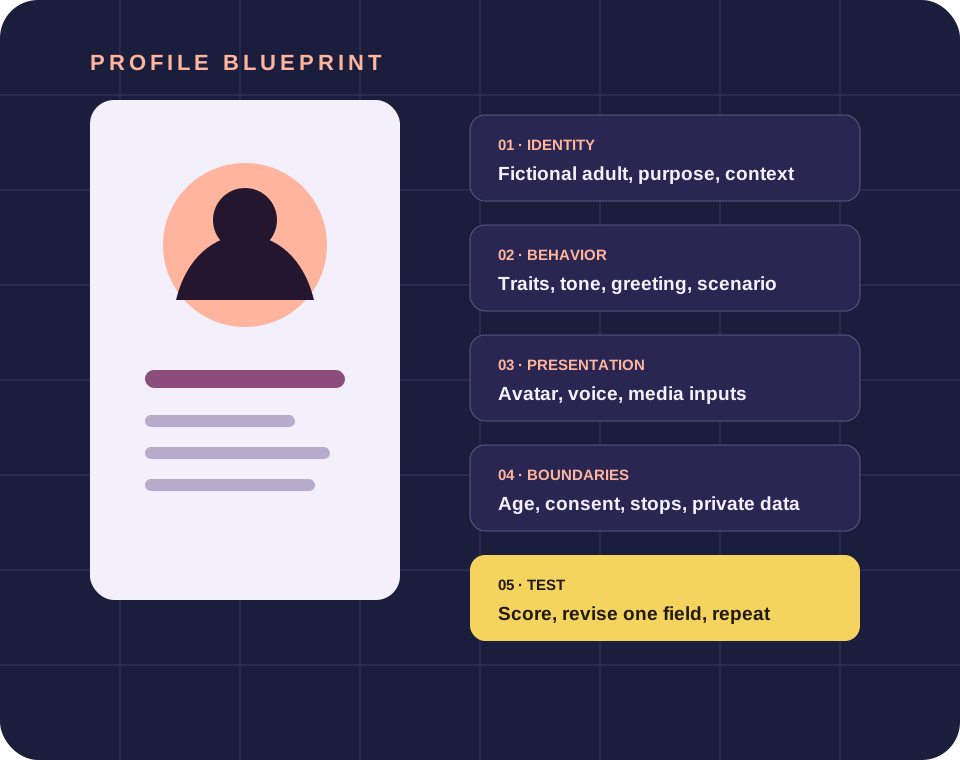
To apply explicit adult-age and fictional-character labels, write the expected profile field and the behavior it should produce before opening a creator. Keep the example fictional, adult and free of private data. Then use a short, repeatable test instead of judging the result from one entertaining response.
Why this profile question deserves its own page
A boundary is useful when it names both the prohibited condition and the behavior that should follow. The narrow intent here is to apply explicit adult-age and fictional-character labels. Keeping that intent separate prevents identity, presentation and safety rules from being mixed into one vague prompt that is difficult to inspect.
A creator interface may expose text fields, sliders, media choices or presets. The labels differ across services, so start with a provider-independent specification. Record what you want the field to mean, what a passing response looks like and which outcome would make you revise or stop. This turns a preference into a decision rule without claiming the tool will behave perfectly.
Use current public documentation for available fields and policies. A public page shows what a provider says at the time checked; it does not establish every account behavior. If the live creator differs, treat the difference as new evidence and update the plan rather than forcing the older description to fit.
A repeatable five-step method
- 01
Define the field
State that the character is a fictional adult and the service is software.
- 02
Reduce ambiguity
Write a direct stop rule that changes the subject or ends the scenario when requested.
- 03
Protect the fiction
Exclude minors, ambiguous age, real-person sexual material and non-consensual scenarios.
- 04
Run a small test
Keep medical, legal and crisis claims outside the companion role.
- 05
Record the revision
List sensitive data categories that neither the profile nor test chat should contain.
Do not add sensitive details to make a test feel realistic. Fictional names, broad locations and harmless scenarios are enough to evaluate identity, speech and boundary adherence. A profile that requires real credentials, health records, precise location or another person’s intimate material is not a safer test profile.
What to check before keeping the field
Adult and fictional status are explicit rather than implied.
A stop request produces a clear, observable behavior.
Real people and private data are excluded by name.
The profile does not present itself as professional care or an emergency resource.
Score each check as clear, unclear or failed. An unclear result is not a hidden pass. Reword one instruction, rerun the same harmless prompt and compare the two outputs. If the issue involves age ambiguity, non-consensual content, real-person likeness or ignored stop rules, leave the unsafe scenario rather than escalating it for evidence.
Interpret the result without overclaiming
A consistent short test can reveal whether the current output follows the written identity, tone, scenario and boundary instructions. It cannot prove future behavior, certify a service or replace the provider’s current rules. Record the date, the profile version and the exact harmless prompts so a later revision can be compared fairly.
If a response drifts, identify the smallest field that could explain it. If several fields conflict, return to the saved draft and simplify. If the tool cannot express a required adult, consent, privacy or stop boundary, that is a product-fit decision rather than a reason to invent a workaround. Keep the choice reversible and preserve an easy exit.
Sources and evidence boundary
These sources support the field design, risk control or provider statement used on this page. Vendor sources are labeled as vendor statements. Government and independent standards provide risk framing. They do not verify a private account or guarantee an outcome.
- Candy AI terms of servicevendor policy · checked August 22, 2026
- U.S. FTC companion-chatbot inquirygovernment · checked August 22, 2026
Frequently asked questions
Does this prove a creator is safe or private?
No. Public features and policies can be reviewed, but they do not prove every system behavior, account configuration or future change.
Is this based on private account testing?
No. This guide uses dated public sources and a reproducible evaluation method. It does not present invented hands-on results.
Why change one profile field at a time?
A controlled edit makes it easier to connect a behavior change with a specific instruction while keeping the earlier draft available.